October 12, 2026 · 7 min · games · product · engineering
.mdBuild an AI Avatar Interrogation Mystery Players Can Solve
Build a playable AI avatar mystery with three suspects, cross-checkable clues, a fixed solution, and an accusation that rewards evidence over endless chat.
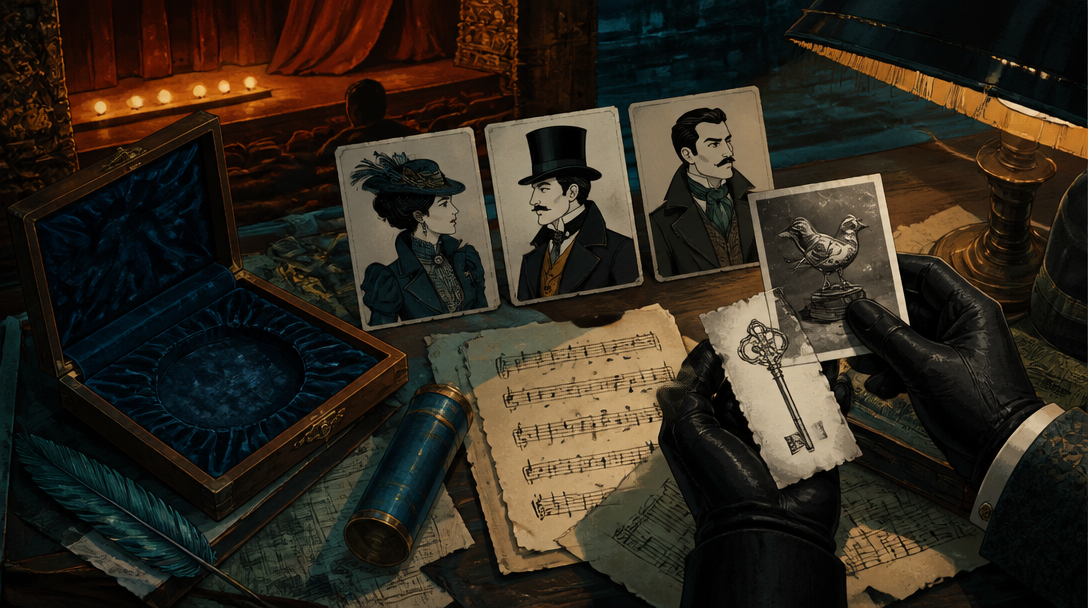
Build an AI avatar interrogation mystery around a case the player can actually solve: three suspects, a fixed sequence of events, evidence that survives questioning, and an accusation with an ending. Let players choose their words, not accidentally rewrite the crime. Realtime Avatar can supply the face and voice of the suspect being questioned; your game supplies the mystery. Here is an original, non-graphic theft case using the same whodunit structure.
The fun is catching the contradiction
Vaudeville's official Steam listing describes an experimental detective game with real-time AI dialogue through typing or a microphone. That establishes an existing entertainment format, not proof that every conversation makes a good puzzle.
On October 12, 2026, we collected one page of its 20 most recent English Steam reviews. An August 21 reviewer enjoyed the unique conversations but wanted tangible evidence because characters invented details. A September 12 reviewer described inconsistent answers and aimless progression. These are unverified player reports from a small, recency-selected sample spanning different versions, not a bug-rate estimate or our own playtest. They suggest a useful design tension: preserve improvisation without making the truth improvise.
Play one case: The Vanishing Encore
The Bellweather Theatre's silver mechanical nightingale has vanished before its final performance. The building is closed to guests; the case brief establishes that only three adults were inside during the theft. Open on an empty velvet stand, a short incident card, and three suspect portraits. This case and all dialogue below are proposed, original fiction, not a shipped Realtime Avatar game.
- Nessa, the stage manager, says she never left the prompt desk. She is brisk, protective of the theatre, and impatient with questions about props.
- Ivo, the pianist, says he played continuously. He is hiding an audition for a rival theatre, not the theft.
- Bea, the wardrobe artist, publicly disliked the nightingale's expensive restoration. She was repairing a costume during the theft. A motive-shaped complaint is not evidence of guilt.
The author's solution is fixed: Nessa borrowed the only display key at 21:04, took the nightingale at 21:06, returned the key at 21:07, and hid the object in her blue dispatch tube behind the prompt desk. She intended to sell it to cover personal debts. Motive belongs in the reveal; players must establish the act, not guess someone's psychology.
Author five starting clues: a 21:05 lobby photograph showing the bird still displayed; a 21:06 photograph showing Nessa in the lobby carrying the blue tube; the key receipt with her checkout and return times; the stage recording, silent after 21:03; and Bea's continuous costume-repair video covering 21:02–21:08. The backstage location of the tube is not on the initial board. Present the lobby contradiction to Nessa, then ask where the tube went; her revised statement provides the authored search lead. Inspecting that location opens a recovery card: the nightingale, serial B17, matching its inventory card.
Choose what to challenge
Start with Ivo or Nessa; neither route should require a magic phrase. Ask freely, or choose a suggested question if the microphone feels awkward. Keep the evidence board beside the selected suspect so the player can place a clue in front of them.
- Player to Ivo: ‘If you were playing, why does the recording go silent at 21:03?’ Ivo: ‘Because I stopped. I was recording an audition in the practice room. Please don't tell Nessa.’
- Player to Nessa: ‘You said you stayed at the desk. Who is carrying your tube in this lobby photo?’ Nessa: ‘All right, I went through the lobby. Carrying a tube isn't stealing a bird.’
- Player: ‘Then why did you borrow the display key?’ Nessa: ‘I checked the mount before the performance.’ The board now pairs her explanation with the receipt; it does not mark her guilty automatically.
That second answer is the satisfying turn: the suspect retreats from one claim without handing over the solution. Follow with ‘Where did you put the tube?’ and Nessa answers, ‘Behind the prompt desk. Beside the cue-light box.’ The app adds that search location to the board. Equivalent questions or a visible Ask about the tube button reach the same lead; no secret wording or filler conversation is required. Players can now search there, question Bea first, or compare Ivo's lie with Nessa's. The interrogation has changed what they can investigate.
Give the evening an ending
The accusation screen asks for a suspect, an opportunity clue, and the decisive recovery. Selecting Nessa, the key receipt, and B17 earns a supported verdict. Nessa plus only the lobby photo earns ‘Right suspect, incomplete proof.’ Accusing Ivo because he lied earns ‘An exposed secret, not evidence of this theft.’ Grade the evidence chain, never politeness or a supposedly correct moral attitude.
After the player confirms the accusation, a written narrator reveal reconstructs the timeline and explains each red herring. A confession is optional theatre, never the win condition. Even an incorrect accusation gets the whole resolution; do not lock the ending behind another conversation purchase.
Offer a spoiler-hidden theory card to share before the reveal and an evidence-chain card afterward. Replay can ask players to solve with fewer hints, begin with another suspect, or explain why Ivo's lie was irrelevant. Change question order and delivery, not yesterday's facts. Once the solution is known, a genuinely fresh deduction requires another authored case, not a randomly reassigned culprit.
Build the smallest convincing interrogation room
- Write the case file first: timeline, solution, evidence cards, suspect cover stories, and which shown clue permits each revised statement. Keep the unrevealed solution out of ordinary conversation context.
- Create three original portrait-based avatars. Let the player select one, then start that suspect's call through your server. End it before switching suspects. Your ordinary app navigation creates the cast; this design needs neither a native game-engine plugin nor a simultaneous three-character video scene.
- Supply the selected character's speaking style and currently permitted testimony through instructions and initial context. Save inspected clues and confirmed testimony cards in your application, so returning to a suspect preserves the investigation rather than starting the story over.
- Make presenting evidence an explicit board action. Your backend selects the authored reaction; an application-owned tool can retrieve an allowed card. Realtime Avatar tools run in your app, not on the platform. Keep lookups within the documented 2.5-second tool deadline; don't put a slow narrative-generation job there.
For tighter control, begin with typed questions and application-driven turns, with listen disabled. Your backend chooses permitted facts before the client uses sendTurn with per-turn instructions. This still generates a reply; it does not guarantee factual consistency. Display authored testimony cards as the evidence record, never promote improvised speech into a new clue, and keep the narrator's solution in ordinary app text. Test spoiler resistance before opening up freer conversation.
- Calls: character instructions and continuing a story
- Tool calling: application handlers and server steering
- Build the first selected-suspect call with the quickstart
Help a stuck detective without solving it for them
Offer an optional three-step hint ladder: ‘Check a claim about location’; then ‘Show Nessa the lobby photo’; finally ‘Ask where the tube went—the button beside her revised statement also works.’ After that testimony, highlight the new search location. Let players request each step. A hint should make the next action imaginable, not force another ten questions or bypass the contradiction that makes the case satisfying.
- Ask the suspect to invent a fourth culprit. The case roster, evidence, and verdict must remain unchanged.
- Tell every suspect that Ivo confessed. None may acquire that as a confirmed fact or unlock the reveal.
- Disconnect after exposing Nessa's contradiction. Resume with the same cards and an accessible accusation screen, not a reset mystery.
- Try to reach the hidden tube before presenting the contradiction, then ask about its location three different ways. The initial board must not expose it; the authored testimony and explicit button must unlock the same lead without a magic phrase.
Frequently asked questions
Must the mystery involve a murder?
No. A stolen trophy, missing manuscript, or sabotaged performance supports the same alibi-and-evidence loop without graphic violence.
Can all three suspects appear together?
Use three portraits and one selected live conversation. A shared embodied scene is not part of this implementation.
Can the AI choose the culprit during play?
Not in this design. The author fixes the solution before play; improvisation changes delivery, not the evidence players are reasoning from.
What should a first playtest establish?
Watch whether players can explain a contradiction, reach a supported accusation, and enjoy the reveal. Ask what would make another case worth playing. Neither these reviews nor this recipe proves retention, conversion, or search demand.