October 9, 2026 · 10 min · education · product · engineering
.mdField Notes: Realtime AI Avatars for Engaging and Scalable Training
Explore how realtime AI avatars transform corporate training, offering scalable, consistent, and interactive learning experiences. Understand creation.
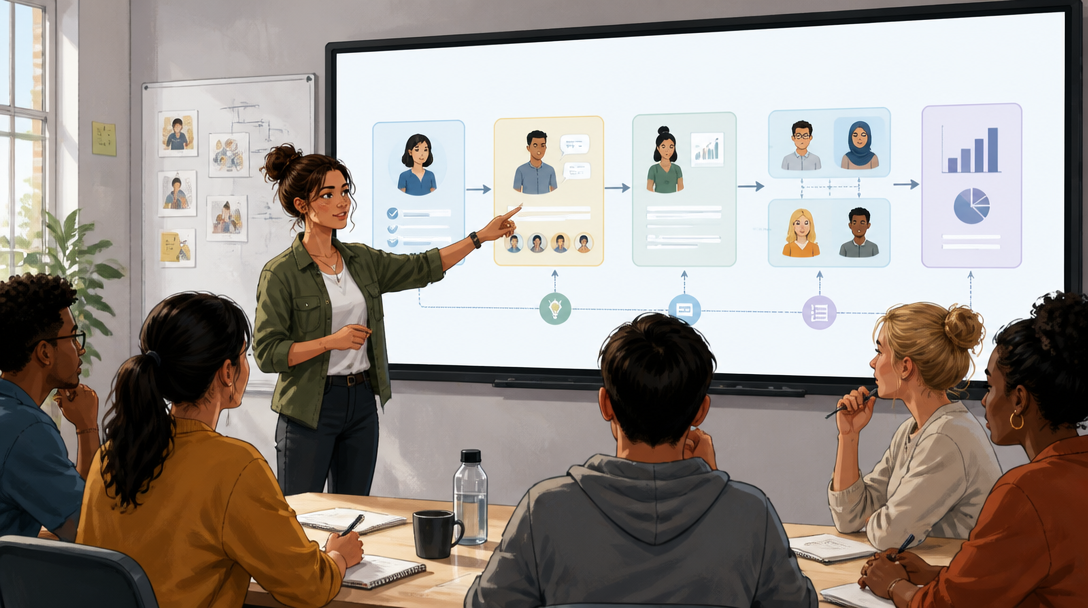
Realtime AI avatars are rapidly redefining the landscape of training and development, offering a powerful blend of scalability, consistency, and interactive engagement previously unattainable with traditional video production. These digital presences enable organizations to deploy uniform, localized content across global teams, reducing the time and cost associated with producing and updating training materials while enhancing the learner's experience through direct, conversational interactions. They move beyond mere video playback to provide a dynamic, responsive learning environment.
The Architecture of Presence in Training
The core utility of a realtime AI avatar in a training context lies in its ability to manifest a consistent, engaging presence that scales on demand. This shifts the paradigm from static, pre-recorded modules to dynamic, adaptable learning experiences. Historically, producing a single 10-minute compliance training video might consume weeks or months; with AI avatars, this workflow can often be condensed to days, while drastically cutting production costs (source:1, source:2).
- Scalability and Consistency: AI avatars ensure uniform messaging and presentation across vast, distributed teams, breaking the dependency on individual human presenters (source:1). Content updates, driven by policy shifts or branding changes, become fluid operations rather than resource-intensive overhauls.
- Multilingual Support and Localization: Platforms enable instantaneous translation and localization across a multitude of languages and accents, making training intrinsically more accessible and inclusive for diverse workforces (source:1).
- Enhanced Engagement and Learning Outcomes: While context matters, interactive AI avatars have demonstrated the capacity to improve learner motivation and retention, fostering a sense of familiarity and direct interaction with complex subjects (source:6, source:10).
- Personalized and Interactive Training: Conversational AI avatars can function as virtual coaches, capable of listening, questioning, responding contextually, and adapting their speech in real-time. This allows for personalized learning paths, continuous automated assessment, and the practice of human-centered skills in simulated, judgment-free environments (source:1).
For scenario-based training, such as customer relations or conflict management role-play, the capacity for real-time interaction is not merely an enhancement—it is the foundation of the learning experience. The avatar becomes a responsive partner, creating simulations that feel genuinely immediate.
Crafting the Avatar and Its Motion
The journey from a single portrait image to a live, interactive avatar is a foundational step in deploying these training tools. The platform generates a looping idle video and a multi-clip motion library from this single frame, providing all the necessary visual assets for a live call. This process is initiated through a straightforward API call (refer to the OpenAPI document for full details) or via the studio interface.
const newAvatar = await rta.createAvatar({
  displayName: "Training Guide Alpha",
  sourceAssetId: "<your_uploaded_portrait_asset_id>",
  motionPrompt: "leans forward slightly, a welcoming expression, then settles back"
});

// Poll getAvatar(newAvatar.id) until status is 'ready' and idleVideoStatus is 'ready'.
The motionPrompt at creation allows for art-direction of the generated resting loop—the avatar's default posture and subtle movements when not actively speaking or gesturing. This loop is a closed arc, meticulously designed to begin and end on the portrait, ensuring a seamless, natural background state. The avatar's motion library comprises short, closed-arc clips—a signature idle variant, a listening state, specific gestures—each returning to its starting point to allow the realtime worker to swap between them without visible seams.
await rta.setLoop(avatarId, {
  motionPrompt: "tilts her head, a small amused smile, settles back to centre"
});

await rta.waitForLoop(avatarId); // Blocks until the new loop is ready and swapped.
It is worth noting that the source loop (the resting loop) is distinct from the clips in the motion library. Directing the source loop changes its behavior without affecting the clips. The system ensures that these movements remain small and within a nearly-still envelope, preserving visual consistency during speech, as a separate model handles mouth animation. Attempting to direct a large, sweeping motion will typically result in a new render that still falls within these subtle constraints, without generating an explicit error (source:docs).
Operational Considerations for Production
Implementing AI avatars for live training requires a nuanced understanding of their operational capabilities and inherent limitations. A key feature for interactive scenarios is full-duplex communication, where the avatar listens continuously even while speaking. This design choice is critical for natural, uninterrupted conversational flow.
- Interruption Handling: Learners can interrupt the avatar mid-sentence, and the system is designed to allow the avatar to acknowledge this naturally.
- Backchanneling: Small verbal cues like 'mm-hm' or a cough do not derail the conversation, making the interaction robust and less brittle.
- Intelligent Pauses: The avatar judges whether a speaker is finished by the content of their utterance, not merely the duration of a pause, preventing awkward silences or talking over the learner.
- Language Adaptation: The system can follow language switches within a single sentence, supporting multilingual learning environments seamlessly.
However, it is equally important to acknowledge the limitations. AI avatars may struggle with emotionally sensitive content, such as leadership training or diversity and inclusion topics, where the nuances of human trust and empathy are paramount. The 'uncanny valley' effect can also pose a challenge, where overly realistic avatars may cause discomfort (source:1). Content accuracy, especially for regulated industries, demands human oversight, as AI-generated content can occasionally be generic or factually incorrect (source:1).
Ethical Frameworks and Transparency
The deployment of AI avatars in training necessitates adherence to evolving ethical guidelines. Transparency is paramount: content generated by AI should be clearly disclosed through visible captions or annotations. For avatars based on real individuals, explicit, written consent is non-negotiable, detailing usage, reusability, and duration (source:1).
- Transparency and Disclosure: Best practices include labeling AI-generated content (e.g., 'Created with AI') and utilizing standards like C2PA/Content Credentials (source:1).
- Consent for Likeness: Obtain explicit, written consent for cloning real persons' voices or likenesses, specifying all usage parameters (source:1).
- Respectful Representation: Ensure avatars avoid reinforcing stereotypes and promote inclusive representation (source:1).
- Risk-Based Oversight: Apply differentiated oversight based on the sensitivity and stakes of the training content (source:1).
Integrating for Live Training Experiences
Integrating a realtime AI avatar into a training application often begins with the SDK. For applications requiring a rich, interactive experience on mobile, the TypeScript SDK provides specific hooks for environments like React Native, enabling deep integration with device capabilities like cameras and audio sessions. The `realtime-avatar/react-native` package, for instance, provides components like `RealtimeAvatarLiveKitRoom` and utilities such as `useAvatarCamera`.
import { RealtimeAvatarLiveKitRoom, AvatarVideoSurface, registerGlobals } from "realtime-avatar/react-native";
import { useAvatarCamera } from "realtime-avatar/react-native";

registerGlobals(); // Must run once at app start for WebRTC globals.

function TrainingSession({ avatarId }) {
  const camera = useAvatarCamera({ allowed: true, active: true });

  return (
    <RealtimeAvatarLiveKitRoom avatarId={avatarId}>
      <AvatarVideoSurface />
      {/* Further UI for interaction, e.g., camera controls */}
    </RealtimeAvatarLiveKitRoom>
  );
}
The `registerGlobals()` call is critical for React Native environments, as it installs WebRTC globals not shipped by default, allowing the avatar to function. Camera sharing leverages existing LiveKit and WebRTC native modules, requiring appropriate permission declarations in your native build configuration (source:docs). Privacy disclosures must be updated to reflect camera images being sent to an AI provider.
From a cost perspective, the usage-based pricing model of realtime avatar platforms differentiates them from pre-rendered video solutions. While minute-based pricing can accumulate quickly for long videos, a model anchored at about $5 per hour of realtime interaction encourages continuous engagement, making it feasible to ship companion applications where learners can converse extensively with their AI trainers. This allows for rich, iterative learning dialogues without prohibitive costs (source:docs, source:pricing).
Shipping an AI avatar for training is a process of continuous refinement. Start by defining clear learning objectives that align with the avatar's strengths—scalable content delivery, interactive role-play, or multilingual support. Create your avatar from a single portrait image, directing its initial presence with a thoughtful motion prompt. Integrate the SDK, focusing on robust error handling and transparent communication about AI involvement. Iterate on content, leveraging the interactive capabilities for personalized feedback loops. Regularly review and update training modules, mindful of ethical considerations surrounding data privacy and consent. The goal is to build an extensible system that evolves with both your training needs and the capabilities of the AI, rather than a static piece of content.
- Realtime Avatar API Documentation
- OpenAPI Specification
- Creating an avatar: One image in, a moving character out
- API reference: Avatars
- Realtime AI avatars with React and React Native
- Realtime Avatar API: Voice or video, on one meter
- Realtime Avatar API: She listens while she talks
- The Silicon Review
- CommLab India
- VirtualSpeech
- Training Industry