September 25, 2026 · 11 min · engineering · api · product
.mdOpen Source Realtime AI Avatars: Assembling Production-Ready Experiences
Exploring the landscape of open source components for realtime AI avatars and the significant engineering effort required to bring them to production.
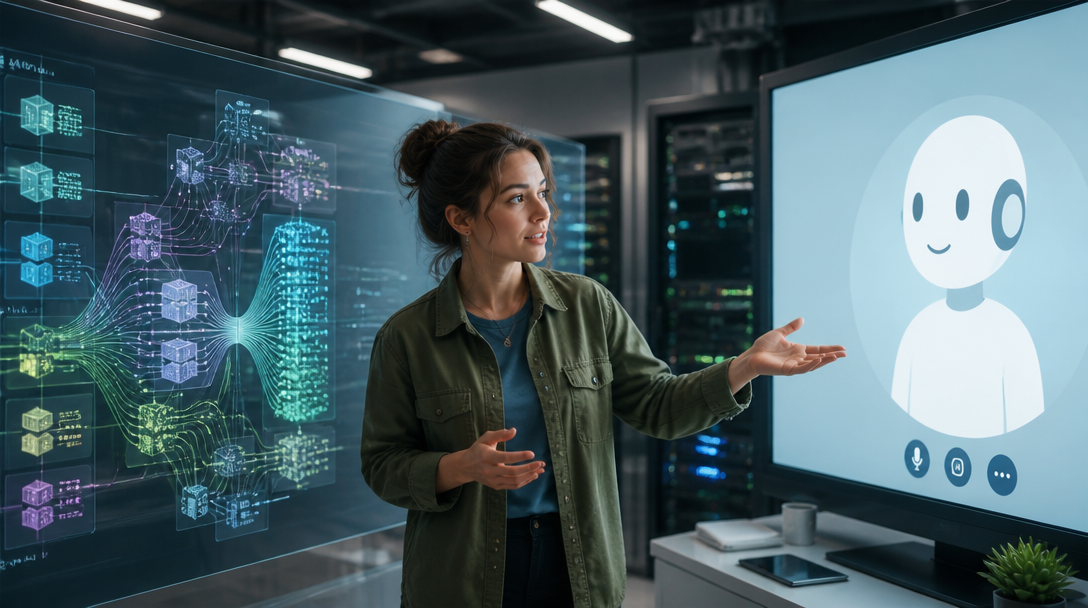
While open source projects offer compelling individual components for building AI avatars, from speech-to-text to visual rendering, assembling them into a truly real-time, interactive, and production-ready system presents substantial engineering challenges. The gap between component capability and a deployable, low-latency conversational experience is often bridged by managed API platforms, which abstract the complex orchestration required to deliver fluid human-like interaction. This approach allows developers to leverage advanced AI models without bearing the full operational burden of maintaining a high-performance, real-time media pipeline.
The Modular Foundation of Realtime Avatars
The architecture of an interactive AI avatar is a layered construction, with each layer typically addressed by specialized models. At its core, real-time interaction necessitates orchestrating several distinct components into a cohesive streaming pipeline:
- Speech-to-Text (STT) or Automatic Speech Recognition (ASR): Transforms spoken user input into text.
- Large Language Models (LLMs): Process the text, generating a conversational response.
- Text-to-Speech (TTS): Converts the LLM's text response back into audible speech.
- Visual Rendering (Avatar Model): Animates a digital character, synchronizing lip movements and other visual cues with the TTS audio.
The open-source landscape offers a rich collection of tools for these individual steps. For visual rendering and lip-sync, models such as Wav2Lip (source:10), SadTalker (source:11), and MuseTalk (source:2) have demonstrated capabilities for real-time performance, often achieving 30 frames per second or more on adequate hardware. Frameworks like AvatarAI offer a full-stack, open-source approach for photorealistic conversations, including zero-shot voice cloning and multi-LLM support (source:2). Projects like LongCat-Video-Avatar focus on efficient, audio-driven avatar generation for long-form content, emphasizing reduced GPU costs and efficient inference (source:3). TalkMateAI aims for a fully local, multimodal AI companion with real-time speech and synced lip movements (source:5).
These initiatives highlight the foundational strength of the open-source community in developing robust AI components. However, it is crucial to differentiate between the availability of powerful individual models and the engineering effort required to integrate them into a production-grade, real-time system that can consistently deliver a fluid, interactive experience.
The Orchestration Conundrum: Real-Time Challenges
The ambition of a truly real-time AI avatar encounters significant hurdles when moving from isolated components to an integrated system. The primary challenge is latency. For a conversation to feel natural, the entire pipeline—from a user's spoken word to the avatar's visual and audio response—must complete within approximately one to two seconds (source:2). This tight window demands highly optimized models, efficient data transfer, and seamless handoffs between each processing stage.
Hardware requirements are another considerable factor. Achieving real-time lip-sync and dynamic visual generation often necessitates specialized, high-performance GPUs, such as V100 or H800 class hardware (source:2). While the software itself may be open source, the underlying compute infrastructure incurs ongoing operational costs, approximately a penny per minute per stream on entry-level cloud GPUs (source:2). This reality means that even 'free' open-source components come with a compute bill for sustained real-time operation.
Beyond raw speed, the engineering of a full-duplex conversation presents intricate problems. A natural interaction allows a user to interrupt the avatar mid-sentence, shifting from a rigid turn-taking model to a more fluid, human-like flow (source:2). Implementing this 'barge-in' capability requires sophisticated real-time audio processing to detect interruptions, coupled with robust LLM interruption logic. Orchestrating these elements reliably across potentially unstable network conditions adds layers of complexity.
The operational overhead of integrating, scaling, and maintaining these diverse open-source components for production-grade latency is substantial (source:2). This includes managing streaming architectures, ensuring stable media pipelines, and optimizing for various client environments. It also requires differentiating between tools designed for offline video generation, like Duix Avatar (source:8), and those built for true interactive real-time presence.
A Path to Production: Integrating with a Managed API
Given the complexities of orchestrating a real-time avatar pipeline, many developers turn to managed API platforms. These services abstract away the challenges of WebRTC, media stream processing, low-latency rendering, and GPU management, allowing builders to focus on the unique conversational logic and application experience. The TIC Realtime Avatar platform, for instance, provides a complete solution for bringing AI avatars to life from a single portrait image. The platform generates the looping idle video and the motion library, ensuring that the video is audio-clocked for perfect lip synchronization.
Our TypeScript SDK, realtime-avatar, is generated directly from our OpenAPI specification (/openapi.json), providing a typed and robust interface for integration. This SDK handles the intricate WebRTC and WebSocket protocols, simplifying the development of interactive applications. Our platform is designed for continuous use, with transparent usage-based pricing anchored at about $5 per hour of real-time interaction, making it viable for live companion apps (/pricing). Avatars are created for a nominal fee of $1 beyond included tiers.
For agents and developers building against our platform, comprehensive documentation is available, including an agent-readable specification at /llms.txt. Our studio at /studio also showcases a roster of resident live avatars that can be used out-of-the-box or as inspiration.
Shipping an Interactive Avatar: Practical Implementation
Integrating a real-time AI avatar into an application becomes a focused task when the underlying complexities are managed by an API. Here’s a look at practical implementation steps using the Realtime Avatar SDK:
Establishing an Avatar Call
The core interaction begins with an AvatarCall component. The SDK simplifies connecting to a live avatar session, whether for full video presence or audio-only interactions. The pricing model is consistent across both modes, priced to encourage leaving the connection on for dynamic experiences.
<AvatarCall client={client} avatarId={avatarId} />                 // she is on screen
<AvatarCall client={client} avatarId={avatarId} mode="voice" />   // audio only
These snippets, for example, illustrate how to instantiate a video or voice-only call. The `client` and `avatarId` parameters link to your authenticated session and chosen avatar.
Monitoring Connection Details
Understanding the health and quality of the real-time connection is crucial for a robust user experience. The SDK provides callbacks to track connection details without requiring complex WebRTC signaling knowledge.
import { useState } from "react";
import { AvatarCall, type AvatarCallProps, type AvatarConnectionDetails } from "realtime-avatar/react";

function CallWithDetails(props: Pick<AvatarCallProps, "client" | "avatarId">) {
  const [details, setDetails] = useState<AvatarConnectionDetails | null>(null);
  return <>
    <AvatarCall {...props} onConnectionDetailsChange={setDetails} />
    {details && <output>Local connection: {details.localQuality}</output>}
  </>;
}
The `onConnectionDetailsChange` callback delivers a snapshot of `connectionState`, `localQuality`, and publisher quality for audio and video streams (source:1). This allows your application to provide feedback to users about their connection quality without delving into low-level network diagnostics.
Enabling Visual Input: The Avatar’s Gaze
To enable the avatar to 'see' and react to the user’s environment, camera input can be integrated. This requires server-side authorization and client-side user permission.
import { useAvatarCamera } from "realtime-avatar/react";

function CameraControl({ allowed, active }: { allowed: boolean; active: boolean }) {
  const camera = useAvatarCamera({ allowed, active });
  return <>
    <p>Share camera images with AI to let the character see what you show.</p>
    <button style={{ minHeight: 44 }} disabled={!camera.available}
      aria-pressed={camera.enabled} onClick={() => void camera.toggle()}>
      {camera.pending ? "Cancel camera request" : camera.enabled ? "Stop sharing camera" : "Share camera"}
    </button>
    <p role="status">{camera.error ? "Camera unavailable. Check camera permissions and try again." : ""}</p>
  </>;
}
The `useAvatarCamera` hook, used with proper `allowed` and `active` states, manages camera access and streaming (source:1). Note that camera images are sampled occasionally for visual understanding, not for continuous motion recognition, and are excluded from server call recordings (source:1).
Avatar Creation Workflow
Creating an avatar itself is an asynchronous process. Developers initiate `create_avatar_from_image` with a single portrait image; the platform handles the generation of the idle loop and motion library. It's important to poll `get_avatar` until the avatar status is `ready` before attempting to initiate a call, as calls to a `preprocessing` avatar will result in an error (source:1).
How to Ship It
The journey from raw open-source components to a polished, production-ready real-time AI avatar experience is paved with engineering challenges related to latency, hardware, and complex media orchestration. While open source offers invaluable building blocks and transparency, the effort required to maintain, scale, and optimize a full stack for a production environment is significant. This includes not just the initial integration, but ongoing management of infrastructure, network conditions, and diverse client environments.
Managed API services like TIC Realtime Avatar provide a pragmatic solution, allowing developers to sidestep these intricate real-time engineering problems. By abstracting WebRTC, video streaming pipelines, and GPU-accelerated rendering into a reliable service, you can dedicate your resources to crafting unique conversational AI, compelling user experiences, and innovative application logic. This approach is not about abandoning open source, but strategically leveraging it where it makes sense (for example, in your choice of LLMs or specific AI models), while offloading the demanding, high-performance real-time media layer to a specialized platform.
The goal is to move beyond proof-of-concept and ship a genuinely interactive product. With an API-driven solution, the focus shifts from managing bytes on the wire to creating meaningful engagements, making the vision of a truly interactive AI companion a practical reality for your users.